



In 2026, leaders navigating market and political shifts will face polycrises.
But out of this chaos lie significant opportunities where next-generation moats are forged.
The secret to achieving growth in this environment, mastered by history’s greatest strategist, Napoleon was a
defensive grand strategy to stabilize the organizational core that developed the
breathing room to transition into sequenced growth maneuvers.
For executive leaders confronting multiple crises that threaten organizational survival and financial performance,
Napoleon’s grand strategy pivot offers a crisis navigation blueprint. The French general transformed countless
challenges including poor army morale, fragmentation and resource scarcity into victory, a process we codify for
executive leaders as the 7 Napoleonic Strategies to Drive Scalable Growth.
The 1796 Parallel: From Crises to Campaign in Your Boardroom
Napoleon assumed command of a demoralized, under-supplied Army of Italy that faced Austrian and Piedmontese forces
outnumbered by a 2:3 ratio. In a corporate setting, this mirrors an underperforming company with low morale, whose
talents and assets are not in a position to directly face the competition.
Here, Napoleon recognized that a substantial enhancement in troop morale was critical for
transitioning his army from a defensive posture into offensive operations. He channelled the fervor of French
liberty ideals in his famous proclamation:
“Soldiers, you are naked, ill-fed!… I am about to lead you into the most fertile plains on earth”, and
“there you will find honor, glory, and riches.”
Napoleon’s troops were immediately won over by his speech, and within days he would begin his offensive pivot.
During Napoleon’s defensive assessment, he applied live scenario planning to determine how to beat his competition of
the Austrian and Piedmontese forces.
In facing such a challenge, the French general would restructure the Army of Italy to emphasize mobility and use of
artillery that would be known as his signature protocol.
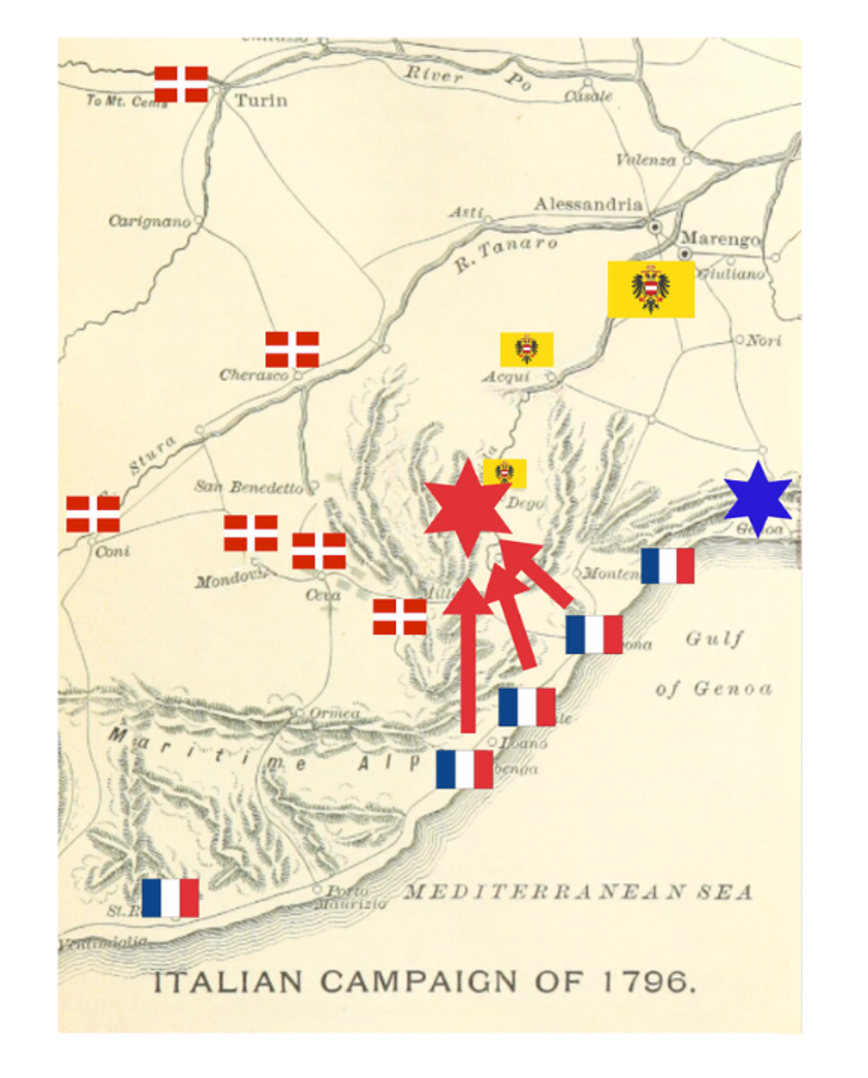
Napoleon deployed his divide-and-conquer tactic for a quick win by splitting up the
enemy armies so that his forces could be positioned in between.
This tactic would cut off the two enemy armies, allowing Napoleon to sever their communication lines of cooperation.
This enabled Napoleon to face the Piedmontese and Austrians separately, a strategy that converted his
numerical disadvantage into a viable, risk-reduced victory. While in hostile territory, Napoleon’s
plan addressed existing challenges including morale and overstretching of resources by achieving a quick, decisive
triumph.
Figure 1 – Napoleon’s Divide-and-Conquer Execution of Dego Seizure
As exemplified in Napoleon’s campaign in Italy, where he faced multiple crises, corporate leaders also commonly face
existential challenges.
From this battlefield context, the following crisis navigation strategies for executive leadership include:
Defensive Pivot
Strategy 1: The Diagnostic Sprint
Corporate Strategy: SWOT Analysis and Pareto Principle (momentum pivot, determining what 20% of challenges
are causing 80% of vulnerabilities).
Strategy 2: Stabilization and Operational Re-optimization
Corporate Strategy: Scenario Planning and Growth Re-optimization (market reinforcement at critical junctures for
growth operations).
Strategy 3: Leadership Growth Vision
Corporate Strategy: Optimal Growth Strategy (rapid executive approval).
Transposing Napoleon’s battlefield strategies for corporate application mimics the competitive drive to achieve
victory. Napoleon’s crisis navigation began with a rapid assessment of his army, recognizing its poor condition.
With a live scenario assessment, he would devise the opportunity to split up competitors and mobilized his army to
secure the critical juncture of Dego.
This hallmark of concentrating resources for seizing a critical market chokepoint will be referred to as the
Dego Doctrine.
The Dego Doctrine refers to the asymmetric advantage gained by seizing a critical chokepoint that permanently
alters the competitive dynamics of the market.
Critical chokepoints in both the battlefield and business settings are not commonly recognized
until they are already captured. For example, in the 2000s-2010s technology industry, search engine
companies with PageRank links and not those owning the physical infrastructure of internet cables captured a
critical market chokepoint.
In the fast-food industry, vertical integration of the supply chain undertaken by McDonalds in the middle of the
20th century led to greater operational and cost controls during scale. This facilitated rapid business
expansion that ultimately positioned the company to become a competitively profitable moat.
In 2026, the chokepoint for AI is not the training model, but where and how profitability emerges across the stack.
For leaders to seize chokepoints, the paths are often shrouded by uncertainty and forged through strategy and
executed into reality.
Returning to Napoleon’s execution of the Dego Doctrine, he deployed a forward brigade (two to four regiments) of his
Army to Italy toward Voltri in order to feint the intention of capturing the city of Genoa and mislead the Austrian
general Beaulieu. The Austrian general reacted to Napoleon’s maneuvers and dispersed its forces
across a wide front from Acqui to Genoa.
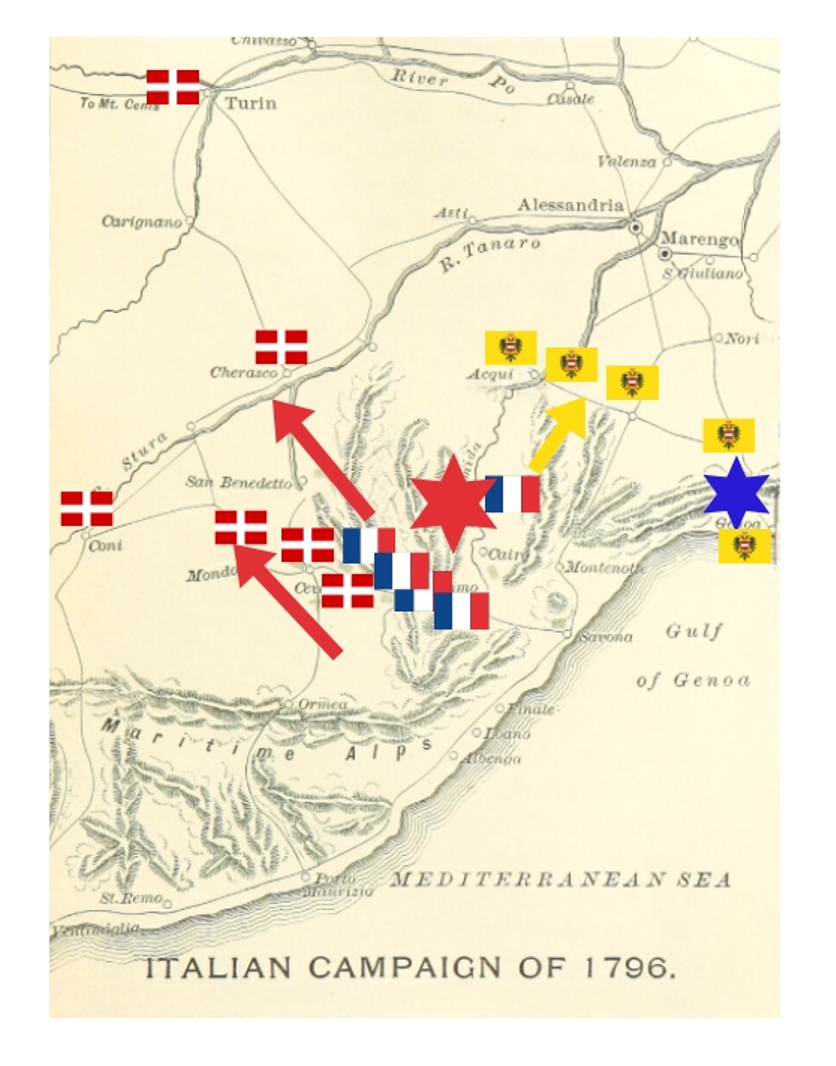
This diversionary feint enabled the French Army of Italy to take on the Piedmontese Army with fewer
Austrian reinforcements and seize the central position of Dego.
Napoleon subsequently implemented the Dego Doctrine that forced the Austrian forces to regroup at Acqui. This
ultimately left the Piedmontese to defend their territory temporarily alone. The French Army would subsequently
fight and take the cities of Ceva, San Michele and Mondovi in the span of five days. These victories forced the
Piedmontese into an armistice with the French and allowed Napoleon to take on the Austrians alone.
Figure 2 – Napoleon’s Italy Campaign Grand Strategy Execution
In his proclamation to the Army of Italy, Napoleon stated, “The two armies which lately attacked you in full
confidence, now fly before you in fear”.
The strategies applied by Napoleon transferred for corporate leadership include the following:
Offensive Sequence
Strategy 4: The Velocity Feint
Corporate Strategy: Diversionary Feint and Dispersion of Competition.
Strategy 5: Execute Dego Doctrine
Corporate Strategy: Concentrate Full Force to Seize Critical Market Chokepoint (analyze what market juncture do
competitors overlook, that if controlled would render their advantage obsolete?)
Strategy 6: Reinforce Asymmetric Advantage
Corporate Strategy: Utilization of Competitive Advantage from Seizure of Chokepoint for Growth.
Strategy 7: Institutionalize Momentum of Victory
Corporate Strategy: Emphasize High-Visibility Wins to Reinforce Growth Momentum.
These strategies utilized by Napoleon
in his Italian Campaign, transferred to executive leaders reveal the leadership mandate when dealing with
crises. While the French general had to beat his competitors, corporate leaders are required to achieve
year-on-year growth while navigating multiple crises.
When business leaders face simultaneous crises, an optimal strategy is to devise and execute a defense-to-offense
pivot executing these 7 Napoleonic Strategies to Drive Scalable Growth.
This begins from a defensive audit to assess the organization’s condition, market trends and determine critical
chokepoints.
By utilizing the organization’s competitive advantage, whether that is asymmetric speed/morale/strategy/technological
innovation and concentrating resources, by using the Dego Doctrine, leaders can execute this resilient growth
protocol to achieve breakthrough outcomes.
Executing the Dego Doctrine and capturing the chokepoint are often the critical factors in
driving organizational profitability and success. Organizations are often limited in financial
resources, and the use of such growth protocol leverages existing teams and departments to develop
moats.
Executive leaders in 2026 who execute the 7 Napoleonic Strategies to Drive Scalable Growth transform organizational
crises into captured chokepoints that build durable, next-generational moats.
Note: Napoleon’s brilliance led to his overextension, and the next article discusses key principles while scaling
growth.
This article is Part 1 of the Scalable Growth Blueprint.
At Athera Systems, we partner with founders and executives to build a permanent competitive advantage.