



While the business landscape is now more volatile than in the past several years combined, executive leaders are not just thriving, they are building disproportionate advantage.
AI is driving measurable ROI, regulatory pressures are reshaping market conditions and economic uncertainty is testing every organization.
When leaders face polycrises, the best executives develop anti-fragile cultures that gain strength during disruption by deploying the three strategic foresight tools including: live scenario navigation, AI force multiplier and lead with grand vision and network leadership.At the core of this solutions protocol is the Grand Strategy Simplification (GSS) — a 5-step mental model to prioritise matters by cutting through complexity to secure proportional leadership outcomes.
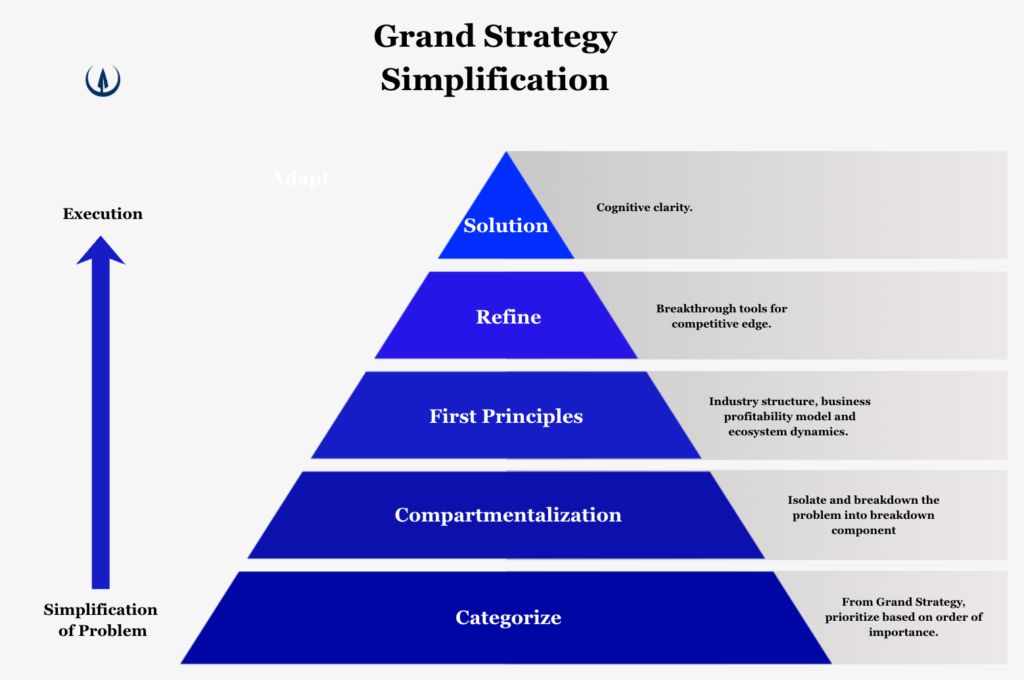
Below are the steps elite leaders use to apply the GSS, classifying and rapidly resolving issues:
First, they categorise matters based on their level of importance, with those of the highest priority requiring the compartmentalisation to first principles. As solutions are developed and executed, an outcome assessment is subsequently undertaken for viability refinement before final outcome delivery.
At Athera Systems we explore and develop frameworks like this with my clients.
For matters of high-order importance, the three strategic foresight tools are deployed that facilitate the planning and execution of strategy
1. Live Scenario Navigation
The Conference Board’s C-suite Outlook of 2026 that surveyed over 750 CEOs identifies uncertainty (43%) as the greatest external challenge for businesses. Organizations bolstering scenario-planning capabilities and agile governance shift the stance from reactive to proactive organizational positioning that is critical for preserving, maintaining and increasing market share.
2. AI Force Multiplier
Elite leaders leverage AI not only for operational efficiency, but also as a core component in developing enterprise-wide strategy to front-run market shifts. As the founder of A16Z, Marc Andreessen notes, the best founders and CEOs will be expected to “be quite skilled at 6 or 8 things and then will be able to cross-pollinate and combine them.” With AI stacks, leaders syntheses historical data and predictive insights from diverse fields in order to optimize high-stakes decision-making
3. Lead with Grand Vision and Network Leadership
Exceptional leaders lead with a compelling grand vision that unifies the entire organization with a shared purpose. They then leverage this vision outward, attracting the networked pillars including top-tiered employees, public/private alliances, cross-industry coalitions and customers that combine together to forge a self-reinforcing cultural and strategic moat. Leaders including Satya Nadella, Jensen Huang and Elon Musk exemplify this network approach that reinforces their organization’s capability for resilient growth through volatility.
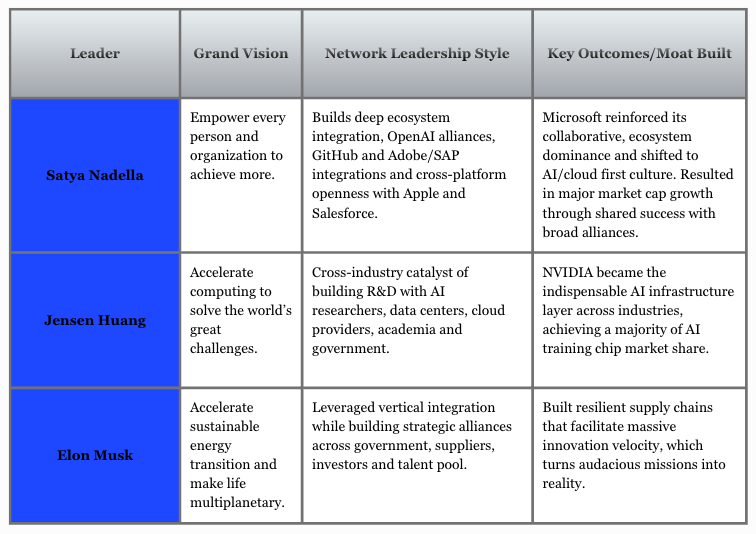
These leaders exemplify a compelling grand vision that creates internal organizational alignment through shared purpose, which the deliberate network leadership style extends. With optimized execution, this result in the building of strategic moats, even in volatile markets.
These three strategic foresight tools combined leverages the development of a robust organizational culture and operations in order to secure disproportionate growth outcomes.
In summary, when elite leaders swiftly diagnose problems using the GSS framework and deploy the three strategic foresight tools that build antifragile cultures reinforces their organization’s capability to dominate in 2026’s market environment.
Navigating leadership crises? Schedule a 30-minute Grand Strategy Navigation Session to simplify your crises and prioritize asymmetric growth.