


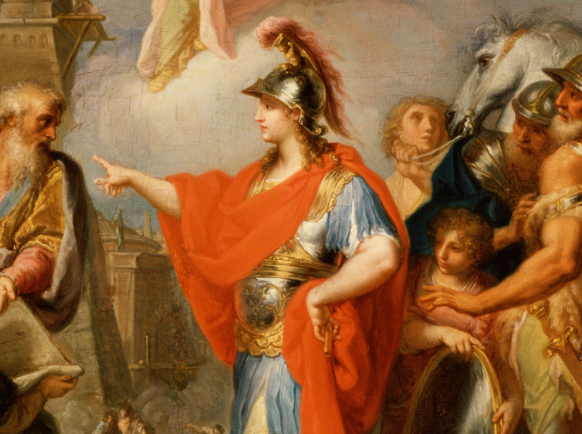
Many industries in 2026 face disruption from AI and quantum computing, forcing businesses to adapt building moats, or risk obsolescence. In this era of accelerated innovation where industries reshape overnight, executives are not just required to outmanoeuvre competitors, but like Alexander the Great, build alliances and develop new ecosystems.
Alexander’s Protocol for Pre-emptive Market Dominance provides the framework transposed for founders and executives to forge unassailable scalable moats. Unlike the Persians who aimed to out scale their competitors, reflecting the strategy of traditional corporations, size is no longer the basis of decisive advantage.
Now, building strategic partnerships and asymmetric advantage are key to forging new moats in the age of AI.
The big question many people business leaders are seeking to answer, “Why traditional service moats are crumbling?”. Bureaucratic business inertia, large workforces and reliance on economies of scale is the same reason Persia became vulnerable against Alexander the Great’s Asymmetric Strategy.
Alexander the Great’s Asymmetric Advantage
Alexander the Great empire was forged on asymmetricbattle strategies that overwhelmed numerical enemy forces, combined with coalition alliance building. Specifically, the strategic advantage that Alexander executed is a Protocol for Pre-emptive Market Dominancethat consists of four principles working in lockstep:
-
- Hammer and Anvil: Fix the competitor in battle with long-piked infantry as the anvil, and exploit their forced response with the cavalry as the hammer to deliver decisive flanking strikes.
- Velocity as Strategic Advantage: Developed an entire army based on mobility as the foundation for strategic advantage, enabling ease of defensive pivots, logistics, morale and rapid deployment. Alexander’s army manoeuvred faster than his Persian competitors that enabled his army to dictate the time and place of battle engagement.3.
- Coalition Building: Built a system for alliance acceptance that would expand and reinforce Alexander’s administrative continuity. Local governors and elites of the Persian Empire were given political and financial incentives for building alliances with the Macedonian emperor. The quick victories by Alexander over the Persians prompted vassal states to seek alliances with the Greeks.
- Third-Perspective Foresight: A Grand Strategy of the entire system of market terrain, battlefield capabilities and enemy and alliance politics was critical for Alexander to forge victory. This is also referred to as the ‘God’s Eye’ overview.
Presenting this pre-emptive system for Alexander to achieve victory over a large Persian empire reveals the significance of asymmetric advantage. In battle, where the Persian’s rigid army relied on overwhelming Alexander with numerical superiority, the Greeks mastered fixing the enemy before striking vulnerabilities using manoeuvrability to achieve decisive, low-cost victories.
Alexander not only beat the Persian army, while being outnumbered 3:2, he rendered their greatest advantage of sheer size to become obsolete and reshaped the landscape of battle.
Where the Persians had superiority in numbers during battle but lost to the Greeks, in the modern businesses setting this ancient dynamic repeats itself.
Large bureaucratic organisations are outmanoeuvred by AI-native firms that rapidly produce similar service outputs at lower costs resulting in a shift in the profitability model across service industries.
Specifically, native AI firms within blockchain, healthcare and supply chain, due to their nimbleness and code-reliant asymmetric reliance to producing their competitive advantage are in the position to increase their market share. This is despite many large organizations within such sectors having access to major budgets for AI, AGI and machine learning.
Yet, the 2025 MIT NANDA research reports that approximately 95% of investments in generative AI produced zero returns, the AI computing costs are reported to significant decrease overtime and outpace that of Moore’s Law. Out of the remaining 5% of AI that is profitable it would be stated by Elon Musk that AI and robotics will make goods and services so cheap that work will become optional. This reflects the inevitable reduction in organizational product output costs as companies enter into AI partnership and achieve profitable win-win outcomes.
For present founders and executives of companies to build pre-emptive dominance for their organizations, the majority of organisations not only financially benefit from integrating AI systems within their operations, but also build partnerships to optimize machine learning (ML) algorithm subsets. Since AI requires a repository of data that the partner companies across industries have propriety access to, this win-win complements the development of a coalition of ecosystems.
AI platforms serve as the modern “anvil” in organizations to preserve programmable progressiveness, whereas ML operationalizes the “hammer” in executing active business tasks. ML algorithms personalize the operational processing of proprietary IP data, and the automation of the decisional flywheels increases the efficiency to generate organizational output.
Additionally, organizations that utilize their custom ML algorithms with AI systems improve high-level executive decision making, reducing repetitive operational costs that result in the development of a competitive advantage.
As a result, this set of modern anvil and hammer, respectively the AI and ML stacks when optimized develops new moats.
With new technology continuously emerging, including that of Web-3, further anvil and hammer infrastructure, beyond that of AI will be developed.
Therefore, the Protocol for Pre-emptive Market Dominance for achieving organizational asymmetric advantage must be perpetually executed.
Taking the Coalition Building and Third-Perspective Foresight strategies from Alexander the Great, it is optimal for founders and executive leaders of organizations to form technological alliances so that when new AI and Web-3 services are developed, they are ready for immediate industry implementation.
This enables organizations within the AI partnership to obtain pre-emptive technological organizational preparedness by seizing the first mover advantage, anticipate market shifts and develop unassailable moats.
Alexander’s asymmetric advantage transposed for founders and executive leadership provides timeless principles that reduce unnecessary business overextension when pursuing growth.
In 2026, where market disruptions are normalized, the Protocol for Pre-emptive Market Dominance offers founders and executives a path to build unassailable moats through strategic partnerships.
This is Part 2 of the Scalable Growth Blueprint.
At Athera Systems we provide founders and executives with the complete Alexander Protocol.