


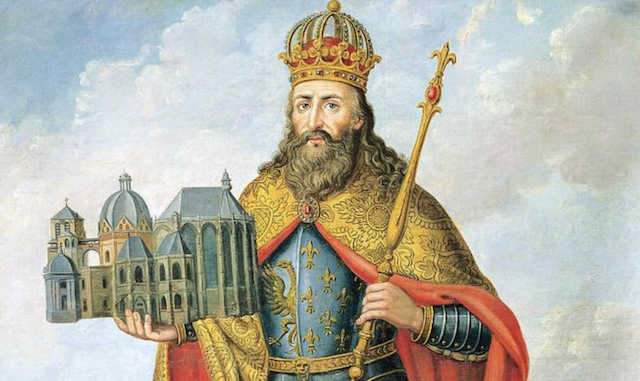
Founders and executives face a major threat that is not competition but the absence of a growth succession system that inevitably leads to organizational decline.
Assess the rise of Charlemagne, who built the Carolingian Empire only for his successors to lose it a generation later. His legacy of developing the precise systems and capitalizing on opportunistic expansion that guaranteed hisascendancy was also the same reason that led to his empire’s disintegration.
Just as empires expand and consolidate, businesses risk dissolution without a Perpetual Growth System (PGS).
A Perpetual Growth System refers to an organizational framework that involves institutionalizing operational and cultural protocols in order to reinforce leadership cohesion and drive indefinite growth outcomes.
In 2026, founders and executives face similar challenges, as companies that spent years developing moats are now facing emerging AI/quantum incumbents that threaten their competitive growth advantage.
This article explores the timeless parallel between Charlemagne’s development of the Carolingian Empire and traditional CEO-led strategy, highlighting the critical mechanisms for PGS integration that prioritizes leadership unity, succession protocols and growth-multiplier execution.
Charlemagne’s Empire Unification Illusion
When Charlemagne inherited the Frankish kingdom, Europe was largely a patchwork of decentralized tribes, each with distinct customs, identities and languages that he unified. By amalgamating Christianity with his empire’s expansion as religious uniformity, Charlemagne would replace tribal pagan culture to achieve administrative continuity.
When the Carolingian Empire was formed in 800 AD, it amalgamated new lands stretching from modern Northern Germany to Spain. Charlemagne implemented the Missi Dominici, a system of royal envoys tasked with enforcing laws and reducing corruption.
This primary tool of administrative oversight served to maintain unity and control across the new empire where communication was slow and challenging.
The Carolingian Empire’s continuity centered on the foundation of Charlemagne, where local lords paid fealty to the emperor in exchange for protection and religious assimilation.
During Charlemagne’s reign within the Carolingian Empire, he managed to maintain relative stability as a result of his noble’s compliance with his vision and collective undertaking, resulting in the distributed expansion of land.
Figure 1 – Beginning and End of Carolingian Empire
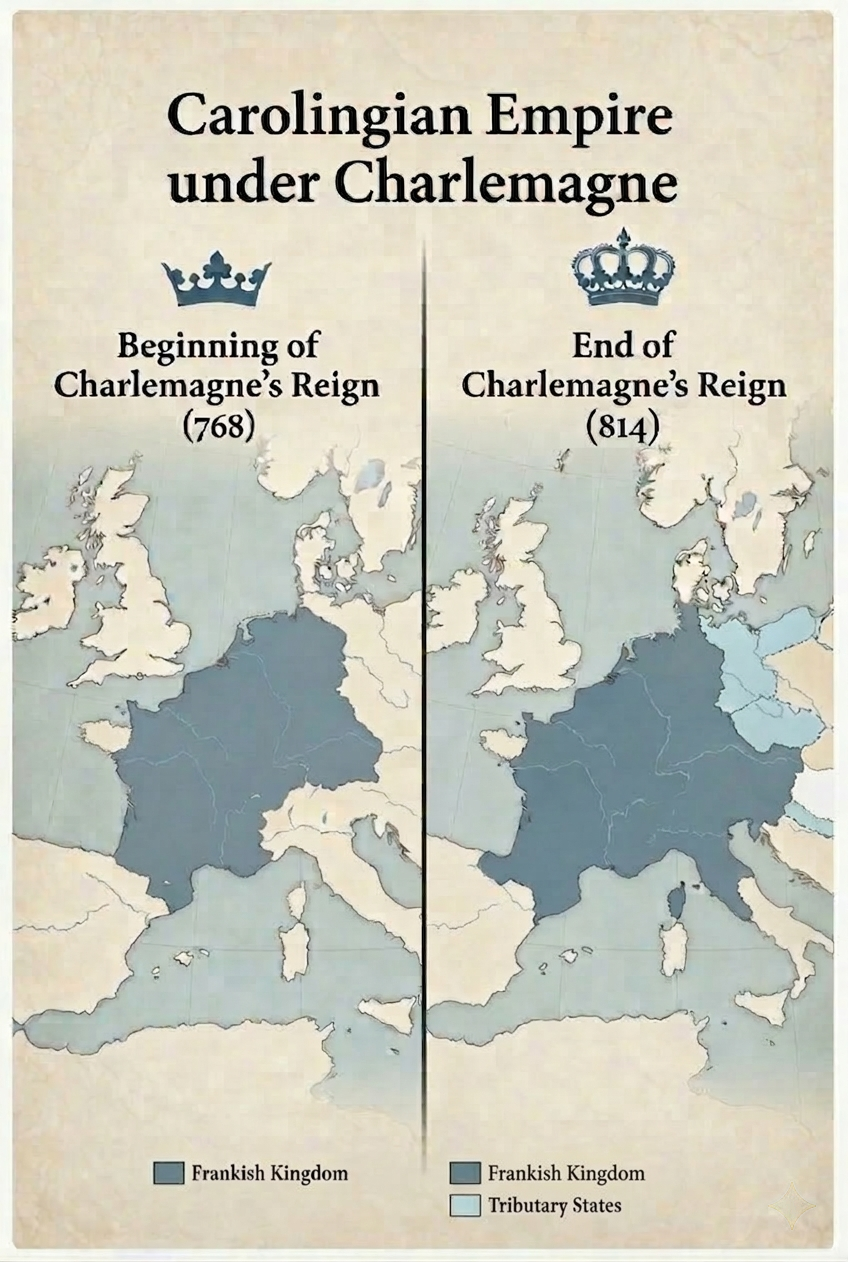
By the end of Charlemagne’s reign in 814 AD, expansion of the Carolingian Empire had stalled. In 813, the year before the death of Charlemagne, his son Louis the Pious was crowned co-emperor. While succession was smooth and unified, Louis in 817 divided the empire among his three sons, sparking resentment due to land distribution. A series of rebellions occurred when Louis’s second wife aimed to secure land for his son, with the other three brothers uniting to depose their father.
After the death of Louis, the series of rebellions transformed into full-scale civil war, ending with the Treaty of Verdun in 843. The three kingdoms of West Francia, Middle Francia and East Francia emerged from this treaty that undertook an irreversible step in the dissolution of the Carolingian Empire.
This partition set off a chain of instability that combined with weakened external defences led to the collapse of the Carolingian Empire.
The Carolingian Empire formally ended in 887, fragmenting into independent kingdoms that evolved into the feudal landscape of medieval Europe.
In less than a century from Charlamagne’s coronation, the empire he had built had collapsed.
Prevention of the Founder’s Collapse
The major reasons that consolidated Charlemagne’s rise were the same causes of the Carolingian Empire’s decline. A lack of established lineage and succession protocols, combined with the inability to compromise over inheritance and the absence of strong shared cultural loyalties created the critical vulnerabilities that led to internal rebellions and eventual empire fragmentation.
The Carolingian Empire that was developed by Charlemagne lacked systems that would ensure post-succession growth. As the empire expanded, the emperor neglected to develop robust institutional and cultural mechanisms capable of withstanding internal conflicts that arose once his unifying presence was gone.
The emperor’s departure draws parallels to executive business operations, where founders, or CEO-led succession results in a decline in growth momentum and leadership division.
This reveals that sustaining organizational growth demands more than just strong leadership but requires the integration of a PGS.
For Charlemagne’s case a PGS would be critical to reinforce leadership succession cohesion while operationalizing administrative and cultural systems to ensure empire continuity.
Historian Paul Freed attributed that, “apart of the problem with the Carolingian Empire is its size … the lack of infrastructure” “not just towns, roads, communication, but social infrastructure”, the lack of an idea of obeying the state or obeying the rule and a tendency, therefore to mix private and public interest”.
The PGS Charlemagne required to sustain his empire would comprise:
- Institutionalize Succession Protocol: A codified framework agreed by the successors in favor of preserving territorial unity. A set of protocols for managing disagreements is developed to ensure orderly resolution.
- Professional Administrative Class: Development of non-hereditary agents, based on meritocracy and standardized training. Compensation of such a class is to be tied to administrative service that would prevent the quid pro quo of Missi Domonici
- Democratize Local Autonomy: Merit-based rotation system for local administrators linked to demonstrated loyalty, economic surplus flywheels and infrastructure investment.
- Cultural Unity Protocol: Review of traditions and shared conventions that facilitate cohesive unity of local and empire-wide identity.
- Decentralize Bound Councils: Period review of operational and cultural protocols that responds to market conditions while renewing unity centered on shared principles.
The Carolingian Empire’s rise centered on the strength of the emperor and his capability to maintain military, cultural and internal coherence. However, once internal peace broke down from within the empire, this resulted in discontinuity and the fragmentation into feudal kingdoms.
Where emperors and aristocrats often experience fractured relations, malignment in vision and objectives, so too are these disagreements common between founders and executives.
While such differences are common as part of human interactions, failure to integrate a PGS can be the principal factor between perpetual growth and dissolution.
In summarizing the rise and break-up of the Carolingian Empire remind founders of the flaws when relying on common business practices. This includes:
- Charismatic Leadership
When charismatic leaders depart, successors commonly lack the personal authority to command the same vision and loyalty. Just as Charlemagne’s son Louis struggled to maintain unity, companies including that of post-Steve Jobs era in Apple have faced scrutiny if the organizational strength can sustain the founder’s original vision.
- Rapid Mergers and Acquisitions
Founders and executives are advised not to build an organization of forced compliance. Instead, it is strongly recommended to develop a culture of shared belief that reinforces organizational growth. Similar to Charlemagne absorbing the territories across modern France and Germany, M&As often see acquired companies reverting to old operational practices, which hinders their economies of scale. A culture centered on unified principles effectively mitigates such issues.
- Top-Down Cultural Mandates
Organizations that enforce cultural mandates through top-down initiatives, including imposing mission statements and training programs without natural employee initiative risk internal cultural stagnation. This includes mandatory corporate value statements and performance reviews tied to “living the values”. During Charlemagne’s reign, the Missi Dominici aimed to ensure laws were enforced, but lacked the authority to build a unified cultural tradition.
For organizations to sustain perpetual growth and unity after leadership succession, the development and integration of a PGS is essential. Founders and executives alike optimize executing a PGS that institutionalize leadership cohesion and drives indefinite value creation.
This is Part 7 of the Scalable Growth Blueprint.
References
Chandler, C. J. (2024). The end of the Carolingian Empire (877-888). In C. J. Chandler, Introduction to the Carolingian age (pp. 130–150). Routledge. https://doi.org/10.4324/9780429061530
Collins, R. (1999). Early medieval Europe, 300–1000 (2nd ed.). Palgrave Macmillan.
Freedman, P. (2012, April 5). 21. The early Middle Ages, 284–1000: Crisis of the Carolingians [Video]. YaleCourses. YouTube. https://www.youtube.com/watch?v=zHAINEybmoAMcKitterick, R. (2008). Charlemagne: The formation of a European identity. Cambridge University Press.
McKitterick, R. (Ed.). (1995). The New Cambridge medieval history: Volume II, c. 700–c. 900. Cambridge University Press.
Nelson, J. L. (2019). King and emperor: A new life of Charlemagne. University of California Press.
Scheuren, C. J. N. (1825). Portrait of Charlemagne (742–Aachen, 814), King of the Franks and Lombards and Emperor of the Holy Roman Empire, standing with a model of the Palatine Chapel [Painting]. Centre Charlemagne (Neues Stadtmuseum), Aachen, Germany.