



For founders and executive leaders to make the profitable decision that complies with the board while dealing with external crises is an art of corporate statecraft. Crises can arise from sudden shifts to market conditions in 2026, including the current oil and recent tariff disruptions.
But as market dynamics continue to change, the key to growth is to avoid executive burnout by implementing the following crisis management protocol.
The Grand Strategy Hierarchy (GSH) is a holistic framework that delivers decisional clarity, equipping leaders with the structure to break down complexities into prioritized action.
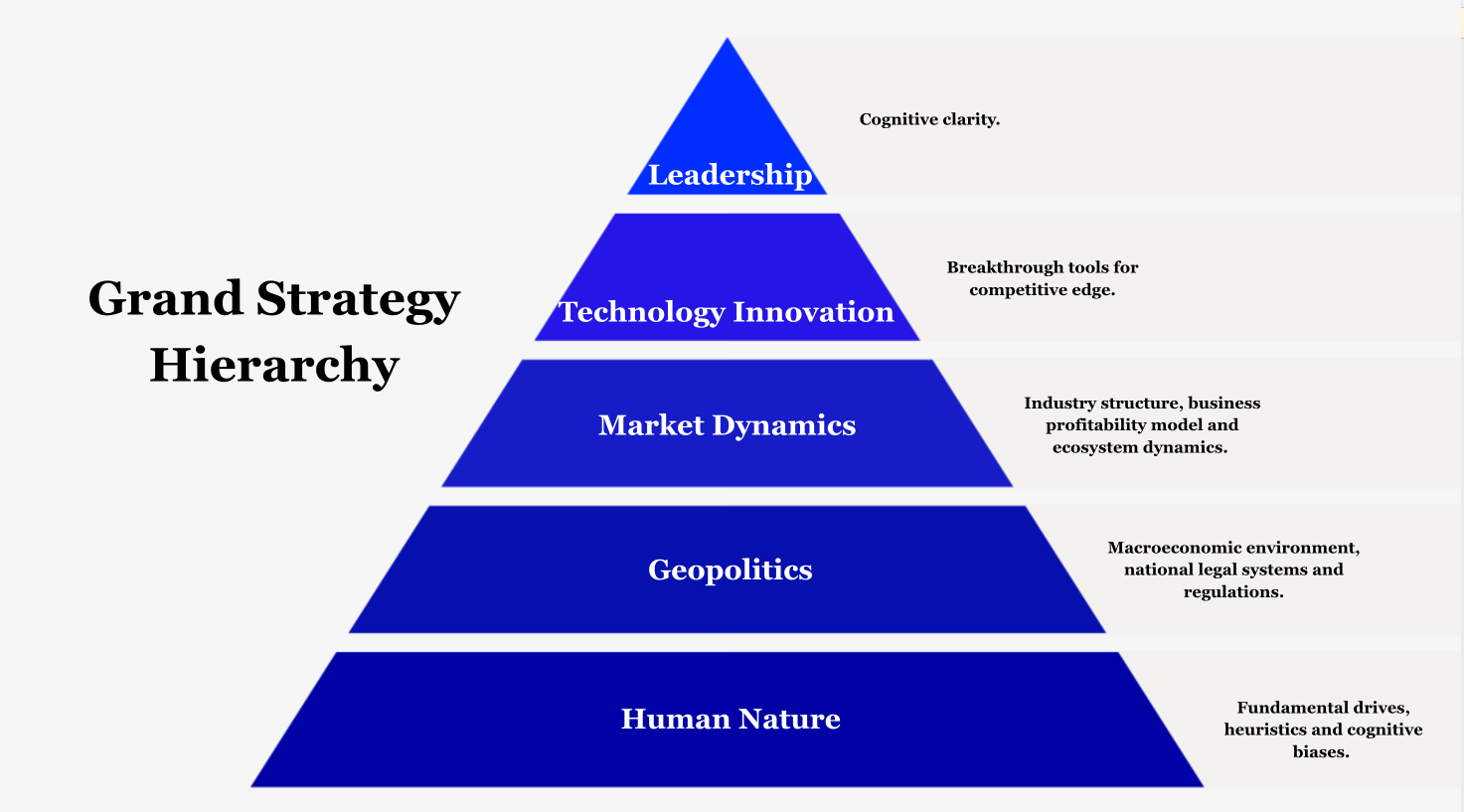
This tiered hierarchy ascending from these bottom-up components promotes the optimization of critical decision-making for both operational, and long-range objectives. This simplifies the fundamental core of every problem that enables leaders to thrive during crises.
The GSH equips executives with:
- First-principles breakdown of fundamental truths to simplify decision-making.
- Prioritization of operational to long-term growth and defense.
- Improvement of signal-to-noise ratio.
For executives to steer the company towards scalable growth, the GSH encompasses the breakdown of the following key components.
Grand Strategy Hierarchy Breakdown
Every decision is fundamentally determined by human nature, which is influenced by innate drives, heuristics and cognitive biases.
Decisions are often made in the context of group psychology, where its accumulation drives geopolitical decisions. This results in the development of market dynamics.
Technological innovation creates market breakthroughs that shifts and refines markets.
Through the analysis of these tiered components provides executives with an encompassing overview of the nature of crises and matters.
The GSH facilitates optimization of decision-making processes to achieve greater signal-to-noise ratios. This increase in clarity promotes the prioritization of critical matters for execution across operational and long-term objectives.
Guideline for GSH Implementation
For effective implementation of the GSH, it is recommended that:
- Executive assistants contribute to developing the components of this framework such that they are on a similar, if not the same level of strategic understanding as that of other executives. This alignment enables the executive team to function effectively in strategic decision-making processes and execution.
- Executive assistants are tasked with updating the GSH for the executive team that simplifies matters and crisis management in real-time.
The GSH is a holistic tool designed to provide leaders with greater clarity and autonomy in optimizing the decision-making process. By implementing this simplification framework, executives can categorize matters including multiple crises, and prioritize growth and defensive execution.
A prime example of corporate turnarounds, that would exemplify the execution of the GSH is how Lego’s executive team navigated the over-diversification crisis in 2003-2004.
Executive Lego Crises Navigation
During the early 2000s, Lego aggressively expanded into capital-intensive areas including the operation of LEGOLAND theme parks, children’s clothing line, media entertainment and core unique product element increases. This push for novelty combined with diversification to strengthen customer loyalty overextended the company with brand dilution. Lego’s company during this period experienced a revenue decline by 40% and reportedly burdened with $800m in debt.
The GSH implementation within Lego’s executive team would provide holistic clarity in reinforcing such strategic turnaround to achieve consistent levels of profitability.
For Lego’s executive team to present the GSH to their board simplifies the key complexities to address the internal-debt and external-competition based crises faced in 2004. What was implemented by Lego’s executive team is in summary, the breakdown of critical components to rediscover its core company identity, prioritizing the physical brick system and building alliances only to return profitability three years later.
The newly appointed CEO in 2004, Jørgen Vig Knudstorp, was tasked to implement a turnaround recovery strategy and reverse its financial losses.
Knudstorp and his executive team introduced the “Back to the Brick” mission that focused on reconnecting to the strategic core of Lego — innate human desires for connection and discovery. This involves focusing on the two-core bond and learn drives of human nature.
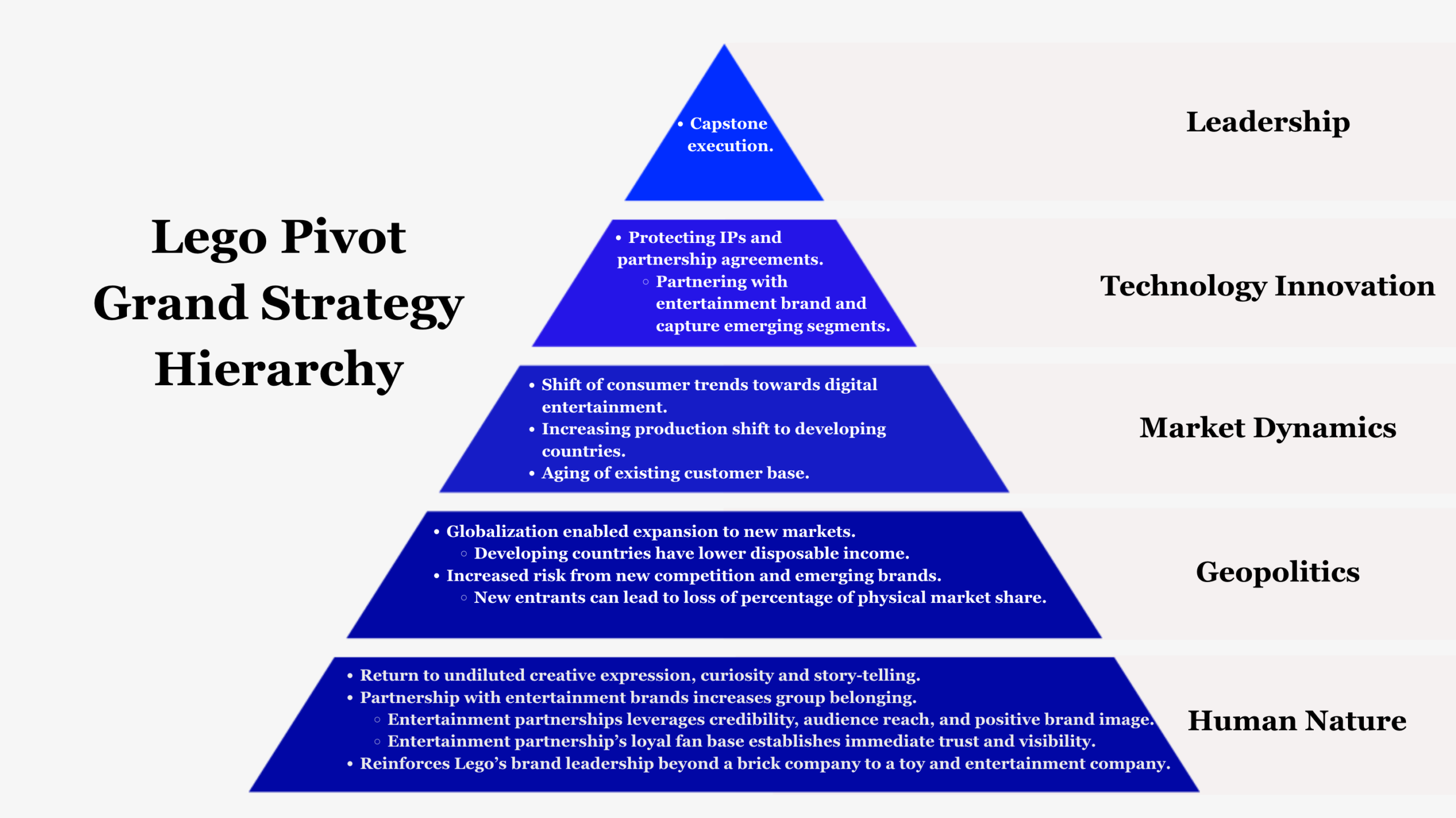
To convert the brand dilution and maintain brand leadership was to leverage Lego’s existing ecosystem and build a strategic partnership network with entertainment companies. This would create immediate trust and visibility between such partnership organisations, which increased the reciprocal audience reach, credibility and positive brand positioning.
This ultimately resulted in Lego to be positioned as a market leader for the physical brick product and avoid facing a range of new incumbent new competitors.
Knudstorp’s strategic execution of LEGO is frequently cited as a significant case of corporate turnaround that involved moving the company across three distinct phases. This is summarized below:
- Stabilization – improve cash flow and operational efficiency by cutting 30% of the workforce, simplified supply chain and implemented rigorous financial controls.
- Growth – prioritize ecosystem building of the core brand to drive sustainable growth by creating IP partnerships, becoming the physical manifestation of digital products and develop community platforms.
- Refocusing – concentrate on the core business of classic LEGO brick system by reducing product complexities, discontinued undermining lines, and divested non-core assets.
The tiered lens of the GSH would have facilitated in providing executive clarity to prioritize the bond and learn humans drives to execute such growth turnaround. By centering on the execution of such executive strategy simplified Lego’s operations that sidestepped competition through prioritizing new partnerships, which built a significant physical ecosystem product network.
This defensive-to-offensive pivot drove Lego’s brand leadership which built an ecosystem moat.
As demanding as LEGO’s turnaround revealed, the GSH would have reinforced Lego’s executive team to execute such turnaround strategy.
Where founders and executives face multiple crises, the GSH serves as a comprehensive decision-making framework.
In summary, the GSH empowers executives with the clarity to transform organizational crises into optimized, scalable growth.
This is Part 6 of the Scalable Growth Strategy.
References
LEGO Group. (2003). Annual report 2003. https://www.lego.com/cdn/cs/aboutus/assets/blte6c97bc4718a1848/Annual_Report_2003_ENG.pdf
LEGO Group. (2004). Annual report 2004. https://www.lego.com/cdn/cs/aboutus/assets/blt07abb4b8a3da3f39/Annual_Report_2004_ENG.pdf
Ringen, J. (2015, January 8). How Lego became the Apple of toys. Fast Company. https://www.fastcompany.com/3040223/when-it-clicks-it-clicks
Robertson, D. C., & Breen, B. (2013). Brick by brick: How LEGO rewrote the rules of innovation and conquered the global toy industry. Crown Business.
The Strategy Institute. (2025). From bankruptcy to billions: Lego’s blueprint for business transformation. https://www.thestrategyinstitute.org/insights/from-bankruptcy-to-billions-legos-blueprint-for-business-transformation